
'SBI is already too big. Too big to fail.' 'It already is a moral hazard. What will it do with 20,000 branches that it cannot do with 14,000, especially in these days of online and mobile banking?'


The Reserve Bank had identified 12 accounts, each having more than Rs 5,000 crore of outstanding loans accounting for 25 per cent of total NPAs or bad loans of banks, for immediate referral for resolution under the bankruptcy law.
'The financial sector will be hit even harder than the overall market.' 'The banking sector will eventually be rescued.' 'But it may go into a long downwards spiral before things turn around.' 'Threat or buying opportunity?' asks Devangshu Datta.
RBI has cited at least 10 areas where it has no control over PSBs.

The NDA government will be following the footsteps of its predecessor, the UPA, which had introduced the concept of "loan mela" to boost credit by directing banks to lend to people through public meetings.

The most pressing issue facing the financial sector is the rising stock of non-performing assets in the banking system
Reserve Bank has almost finalised the structure of Central Fraud Registry.

The laggards include FMCG (16 per cent), Energy (37 per cent) and Media (34 per cent).

'If the government spends Rs 10 lakh crore this year then you would be looking at a GDP growth of minus 5 per cent.' 'If you do not do this, you will be looking at GDP growth between minus nine and minus 10 per cent.'
The country's largest bank registered a consolidated net profit of Rs 4,448.15 crore in the same quarter last year.
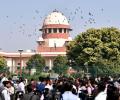
The Supreme Court on Wednesday said the Centre should implement "as soon as possible" the interest waiver on loans of up to Rs 2 crore under the RBI's moratorium scheme in view of the Covid-19 pandemic, saying the common man's Diwali is in the government's hands.

Finance Minister Nirmala Sitharaman has rebutted Congress leaders Rahul Gandhi and Randeep Singh Surjewala's allegations regarding "wilful defaulters, bad loans and write-offs", and stated that they have "attempted to mislead people in a brazen manner".
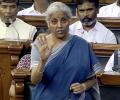
India is facing no risk of recession or stagflation as macroeconomic fundamentals of the economy are strong, Finance Minister Nirmala Sitharaman said on Monday. Replying to a debate on price rise in the Lok Sabha, she said the GST collection and Purchasing Managers' Index (PMI) are indicating that the Indian economy is getting more robust. The GST collection rose 28 per cent to touch the second-highest level of Rs 1.49 lakh crore in July. GST, introduced in July 2017, touched a record high of Rs 1.68 lakh crore in April 2022.
India's Gross Domestic Product (GDP) is expected to expand by 9.2 per cent in the current financial year, according to the Economic Survey 2021-22 tabled in the parliament on Monday. "Advance estimates suggest that the Indian economy is expected to witness real GDP expansion of 9.2 per cent in 2021-22 after contracting in 2020-21. "This implies that overall economic activity has recovered past the pre-pandemic levels," Economic Survey noted. Almost all indicators show that the economic impact of the "second wave" in Q1 was much smaller than that experienced during the full lockdown phase in 2020-21 even though the health impact was more severe, it said.

Aggressive rate hikes by the US Federal Reserve could result in a flight of capital from emerging markets like India, says B Gopkumar, chief executive officer, Reliance Securities.
As of December 2014, NPAs of PSU banks were at Rs 2,60,531 crore.
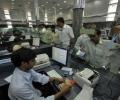
Banks need assistance to complete projects that they have taken over

Banks have started organising silent demonstration in front of houses of defaulters.
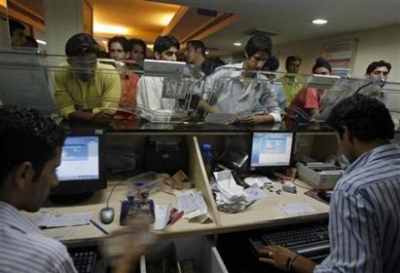
United Bank of India and Andhra Bank employees start organising silent protests.

Amid uncertainties arising out of the second wave of COVID-19, the Reserve Bank on Thursday said that a durable revival of private consumption and investment would be critical for sustaining economic growth post-pandemic. Observing that 2020-21 has left a scar on the economy, RBI in its annual report said, "in the midst of the second wave as 2021-22 commences, pervasive despair is being lifted by cautious optimism built up by vaccination drives." The second wave of the pandemic has prompted revision of growth projections for the current fiscal and the consensus appears to be gravitating towards RBI's forecast of 10.5 per cent, the report added.

Amid an increase in localised lockdowns across the country, Reserve Bank Governor Shaktikanta Das on Wednesday said there is no need for a loan repayments moratorium at present, stating that businesses are better prepared to face the situation. It can be noted that the RBI had announced a six-month moratorium in the early days of the national lockdown last year to help borrowers impacted by a chilling in economic activity. The entire state of Maharashtra is in a lockdown for non-essential services and localised and night lockdowns are being observed in many pockets of the country, including the national capital, to restrict the surge in cases.

Rating agencies Crisil and Icra on Monday revised down their India growth projections for the current fiscal and the second quarter mainly due to the ripple effect of slowdown in global growth and mixed crop output. Crisil downgraded the India growth forecast by 30 bps to 7 per cent while Icra pegged the economic expansion at 6.5 per cent for the second quarter of FY2022-23. "We have revised down our forecast for real gross domestic product growth to 7 per cent for fiscal 2023 from 7.3 per cent, primarily because of the slowdown in global growth that has started to impact our exports and industrial activity.
The CIC's directive came while deciding on a plea by Lucknow-based activist Nutan Thakur, who had based her RTI application on some media reports that RBI deputy governor Viral Acharya in a lecture in 2017 had said accounts of some loan defaulters have been sent to banks for resolution.

Mallya failed to repay loans worth Rs 7,200 cr, did not pay salaries, did not deposit PF, and did not pay income tax. It is still a mystery why banks continued to pour money into the airline when it was on life support

The decision to do away with Rs 500 and Rs 1,000 notes accelerated the slowdown in economic activity with growth averaging 6.8 per cent in the seven quarters after it, as against an average of 8 per cent in the six quarters preceding it, says former chief economic advisor Arvind Subramanian.

Central bank likely to keep tabs on large wilful defaulters; policy likely by month-end.

'Sectors that had been left out till now will also start participating in the rally.'

'I hope the trend is sustainable and that economic activity accelerates going forward.'
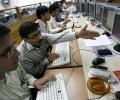
SBI was the top gainer after it reported lower-than-expected rise in bad loans
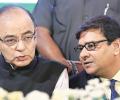
'The finance minister has messed up the economy.'

Mallya, whose Kingfisher Airlines owes money to several banks, had on Thursday said he will challenge UBI's decision to declare him a willful defaulter.

During a three-hour long virtual meeting with CEOs of large public and private sector banks along with heads of NBFCs, the prime minister assured them that the government is ready to take all steps to support the financial sector.

The public sector banks are not in a position to cut rates because of their weak balance sheets and massive portfolios of non-performing assets, says Devangshu Datta.
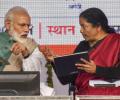
Between August and September Finance Minister Nirmala Sitharaman toured the length and breadth of India meeting traders, experts and entrepreneurs to gauge the pulse of the nation, reports Ruchika Chitravanshi.
Why are investors gung-ho about State Bank? asks Tamal Bandyopadhyay.

K C Chakrabarty, former deputy governor, RBI, talks to Anup Roy on issues in the new bankruptcy law and rules.

SBI had a tough journey in the last 40 years.
The bank had a consolidated net profit of Rs 4,714 crore in the corresponding quarter last year.

Kerala floods take a toll on small businesses, NBFCs brace for losses
